Custom Eyewear Cost: Why Similar Frames Have Different OEM/ODM Prices
Why Similar Eyewear Frames Can Have Different Custom Prices?
A lot of buyers send us two frame photos and ask a very normal question:
“These two styles look almost the same. Why is the price different?”
We understand why people ask this. From a photo, two optical frames or sunglasses may look close in shape. Same front shape, similar temple, similar color. But once the frame goes into real production, the cost is often decided by details that are not easy to see in the picture.
Sometimes the difference comes from the acetate sheet. Sometimes it is the hinge, the plating, the polishing time, the mold, or even the packaging requirement. One small change on the drawing can add extra machine work or hand finishing.
That is why a custom eyewear quotation is never based on shape only.
At LanRol Optical, when we quote an OEM or ODM eyewear project, we usually look at the full production situation: material, order quantity, mold condition, structure, logo method, finishing, packaging, and inspection standard. All of these details affect the final price.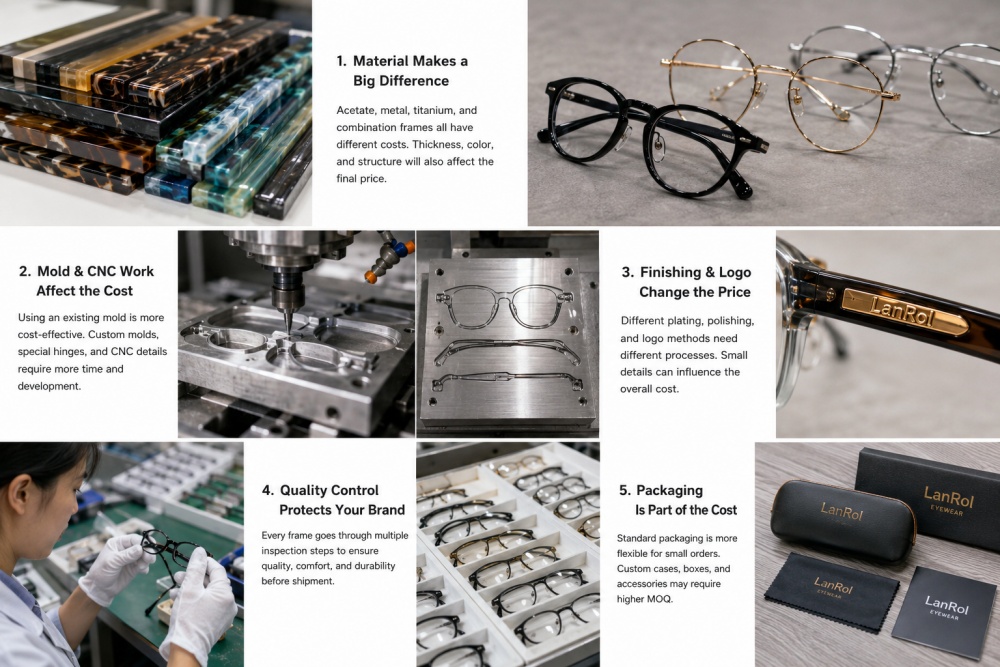
Material Usually Decides the First Price Range
The first thing we check is the material.
For acetate frames, the cost can change a lot depending on the sheet quality, thickness, color, and structure. A simple black acetate frame and a thick laminated acetate frame may look similar in a photo, but the production time is not the same.
Transparent acetate is a good example. It looks clean and premium, but it also shows small scratches, dust marks, and polishing problems more easily. So the factory needs to spend more time controlling the surface.
Thick acetate also costs more, not only because it uses more material, but because cutting, heating, shaping, and polishing take more time. If the front has sharp corners, deep cutting, or a special bridge shape, the work becomes even more complicated.
Metal frames are different. For metal eyewear, the cost depends on the metal type, rim structure, welding points, screws, nose pads, plating, and temple design. A simple full-rim metal frame is usually easier to produce than a thin frame with several small welding areas.
Titanium frames are normally more expensive than regular metal frames. The reason is simple: titanium is lighter, stronger, and more corrosion-resistant, but it is also harder to process. Cutting, welding, polishing, and adjustment all need more experience.
Combination frames also need careful control. For example, an acetate front with metal temples may look very nice, but both materials must fit well together. If the assembly is not accurate, the frame may look unbalanced or feel uncomfortable.
So even when two frames look close from the outside, the real production cost can be quite different.
Small Orders Still Need a Lot of Preparation
Many new eyewear brands want to start with a small quantity. This makes sense. Nobody wants to invest too much before testing the market.
But from the factory side, a small order still needs preparation.
We still need to check the material, confirm the color, arrange workers, adjust machines, prepare logo work, make samples, inspect accessories, and control quality before shipment. These steps do not disappear just because the quantity is smaller.
This is why the unit price for a small order is usually higher. The setup cost is shared by fewer pieces.
MOQ may also be affected by the supplier side. For example, a special acetate color may require a minimum sheet order. A custom case may have its own MOQ. A special logo process may need tooling. These parts are not always controlled by the frame factory alone.
For a first order, we usually suggest keeping the project simple:
Use an existing frame shape if possible.
Choose stable colors first.
Start with a clean logo on the temple or lens.
Use standard packaging before making fully custom retail packaging.
This way, the brand can test the market with lower risk.
Existing Mold or New Mold Makes a Big Difference
One of the biggest cost differences comes from mold development.
If you choose an existing frame model and only change the color, lens, logo, or packaging, the cost is much easier to control. This is a common choice for private label eyewear brands, importers, and wholesalers who want to move faster.
But if you want a completely new shape, special size, unique bridge, exclusive temple design, or custom hinge structure, the factory may need to make a new mold or prototype. This increases both cost and lead time.
CNC work can also change the price.
Some designs look simple on the screen, but they require more cutting time in production. Deep bevels, sharp edges, engraved logos, irregular lens shapes, and special bridge details all need more machine work and more hand finishing.
A clean design is usually easier to produce. A complicated design may look more premium, but it also needs more time, more checking, and more control during production.
This is why we always ask customers for reference photos, drawings, size details, or samples before giving a serious quotation. The more clearly we understand the structure, the more accurate the quote will be.
Finishing Is Not Just About Appearance
Finishing is another detail that changes the price.
For acetate frames, polishing quality is very important. A good acetate frame should feel smooth in the hand. The edges should be clean, the surface should be bright or evenly matte, and the shape should not look twisted after adjustment.
Good polishing takes time. If the frame is thick, transparent, or has many angles, it takes even more work.
For metal and titanium frames, finishing may include shiny plating, matte plating, brushed finishing, two-tone color, mirror polishing, or special coating. Some finishes are simple. Some need more steps and stricter inspection.
For example, a poor plating process may cause color difference, surface marks, or weak coating. These problems may not appear in the first photo, but they can become complaints after customers receive the product.
So when comparing prices, buyers should not only compare the frame shape. The finishing standard also matters.
Logo and Packaging Can Also Affect the Quote
Logo customization sounds like a small thing, but it can change the cost too.
A simple printed temple logo is usually easier to arrange. A lens logo is also common. But metal logos, deep engraving, special logo plates, or logo work in difficult positions may need extra tooling or manual work.
The same applies to packaging.
Standard cases and cleaning cloths are easier for small orders. Custom cases, paper boxes, pouches, hang tags, barcodes, and retail packaging may need higher MOQ and longer preparation time.
For new brands, we normally suggest starting with simple but clean branding. For example:
Temple logo
Lens logo
Cleaning cloth logo
Standard case with logo
This already gives the product a professional look without making the first order too complicated.
After the market is stable, the brand can upgrade the case, box, and full packaging set.
Quality Control Is Part of the Real Cost
A very low price may look attractive at the beginning, but eyewear is not only a fashion item. It has to fit well, open and close smoothly, hold the lenses correctly, and feel comfortable on the face.
If quality control is weak, many problems can happen:
Loose hinges.
Uneven temples.
Lens fitting issues.
Scratches.
Wrong logo position.
Poor polishing.
Unstable plating.
Frame imbalance.
These problems cost more later, especially for brands selling online or supplying retail stores.
A professional eyewear factory needs to check the frame during production and before shipment. We usually pay attention to frame symmetry, hinge movement, screw tightness, lens fitting, polishing, plating, logo position, nose pad position, and final adjustment.
Good QC takes time, but it protects the buyer’s brand. For B2B eyewear buyers, stable quality is often more important than getting the lowest possible unit price.
How to Control Custom Eyewear Cost
Not every project needs an expensive solution. The better way is to match the design with the budget and market plan.
If you are starting a new eyewear brand or testing a new collection, here are some practical ways to control cost:
Use existing molds for the first order.
Avoid too many colors in one collection.
Choose stable acetate or metal colors.
Keep the frame structure clean.
Confirm logo position before sampling.
Use standard packaging first.
Prepare clear photos, drawings, or size details.
Start with a trial order before developing exclusive molds.
This approach saves time and reduces risk. After the first order sells well, you can move step by step into exclusive frame shapes, special colors, and custom packaging.
What to Prepare Before Asking for a Quote
If you want a more accurate quotation, it helps to send clear information at the beginning.
You can prepare:
Frame photos or reference samples
Material requirement
Frame size
Color requirement
Lens type
Logo position
Order quantity
Packaging requirement
Target market or price range
With these details, the factory can understand your project faster and give a more realistic quotation.
Without this information, the quote can only be a rough estimate.
Final Thoughts
Two eyewear frames may look similar in a photo, but the production cost can be very different. Material, thickness, mold, CNC work, finishing, logo, packaging, MOQ, and quality control all affect the final OEM/ODM price.
A good quotation should not only be cheap. It should be clear, practical, and suitable for your market.
At LanRol Optical, we work with eyewear brands, importers, wholesalers, and private label customers on optical frames and sunglasses. We support acetate, metal, titanium, aluminum, and combination eyewear projects.
Whether you are starting with existing models or developing a new custom design, we can help you check the material, structure, MOQ, finishing, branding, and quality details before production.
Looking for a custom eyewear manufacturer for your next collection?
Send your frame idea to LanRol Optical and we will help you prepare a practical OEM/ODM quotation